Table of Contents
ToggleA miter saw is one of the most rewarding tools to own if you’re tackling trim work, framing, or crosscutting lumber. If you’re looking at Skil miter saws specifically, you’re considering a brand that’s been around for decades and offers solid value for homeowners and serious hobbyists. This guide walks you through what makes a Skil miter saw tick, how to pick the right model, and the techniques that will have you making clean, square cuts from day one. Whether you’re hanging crown molding or building a deck, understanding your saw’s capabilities, and limitations, is the difference between a job done right and one you’ll regret.
Key Takeaways
- A Skil miter saw provides precision angle and crosscutting capabilities for trim work, baseboards, and framing projects that handheld saws cannot reliably match.
- Choose between 10-inch saws for trim and molding work or 12-inch saws for deeper cuts on larger structural lumber based on your primary projects.
- Skil miter saws should feature a laser guide, sturdy fence system, and dust collection port—prioritize fence stability and motor reliability over unnecessary premium features.
- Proper setup with a level base, perpendicular fence alignment, and blade verification ensures accurate cuts from the start and prevents compounding errors across multiple pieces.
- Always wear safety glasses, use clamps to secure workpieces, keep hands at least 12 inches from the blade, and employ stop blocks for repeated cuts to maintain both accuracy and safety.
- Maintenance, clean technique, and respecting the tool matter far more than equipment cost—measure twice, let the saw do the work, and prioritize consistent execution over rushing cuts.
What Is a Skil Miter Saw and Why It Matters for DIY Projects
A miter saw is a stationary circular saw mounted on a pivoting arm that cuts wood at precise angles. The blade drops down toward a fixed fence and table, giving you repeatability and accuracy that a handheld circular saw simply can’t match. Skil miter saws come in single-bevel and dual-bevel models: the bevel angle lets you tilt the blade left or right for angled cuts (like 45-degree miters on baseboards).
For DIY work, a miter saw shines when you’re crosscutting lumber to length, making angle cuts for trim, or ripping thin pieces. A compound miter saw adds a second axis of adjustment, letting you cut both a miter (angle across the board width) and a bevel (angle along the thickness) in one pass, essential if you’re building crown molding or architectural trim. Single-bevel saws tilt one direction only, requiring you to flip the workpiece for opposite angles.
Why does this matter? Trim work makes up a huge chunk of finishing a renovation, and a miter saw eliminates the learning curve and wobbly angles you’d fight with a handheld saw. Skil models are built to handle this work without requiring a workshop’s worth of space.
Key Features That Set Skil Miter Saws Apart
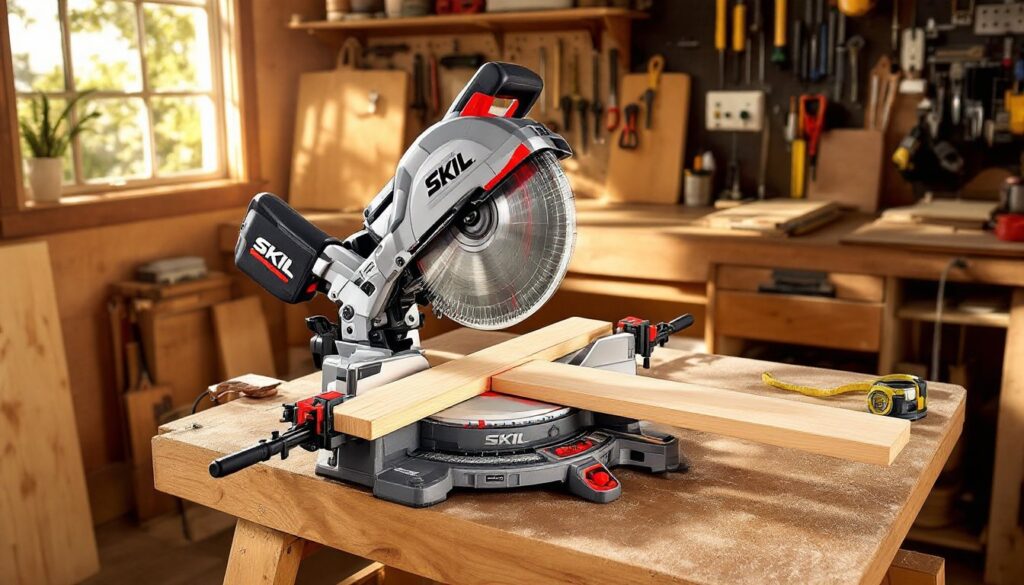
Skil’s lineup focuses on durability and straightforward operation. Most models feature a laser guide that projects a line onto the workpiece so you can see exactly where the blade will cut before you trigger it. This is a game-changer for accuracy and takes the guesswork out of alignment.
Blade diameter varies, you’ll see 10-inch and 12-inch saws most often. A 10-inch saw is lighter, more affordable, and handles trim and molding work beautifully. A 12-inch saw cuts deeper stock and wider boards, though it’s heavier and takes up more bench space. Cutting depth matters: a 10-inch blade on a standard miter saw cuts about 5½ inches deep: a 12-inch saw reaches 7 to 8 inches.
Motor power (typically 15 amps for corded models) and RPM (revolutions per minute, usually 3,000–5,200) also affect cut quality. Higher RPM produces a finer kerf and cleaner finish. Skil saws are usually corded, which means unlimited runtime, no battery fade mid-project, but you’re tethered to an outlet.
Look for a laser guide, dust collection port, and a sturdy fence system that locks tight. A fence that wobbles will throw off every cut. Portability matters too: some Skil models come with a folding stand or are light enough to move between rooms.
Choosing the Right Skil Miter Saw Model for Your Needs
Start by asking yourself what you’ll cut most. Trim work, baseboards, crown, casing, lives in the 10-inch saw wheelhouse. If you’re framing a deck, cutting 2×12 joists, or handling structural lumber, a 12-inch saw is worth the extra cost and space. Budget matters, too: Skil saws range from budget-friendly entry-level models (around $200–$300) to premium compound saws ($400–$600+).
For occasional DIY projects (hanging trim in a bedroom, building bookshelves), a basic 10-inch single-bevel saw does the job. For serious hobbyists or multiple rooms, a compound model eliminates the need to flip workpieces for opposing angles, cutting your setup time in half.
Make sure the model you choose fits your shop. Measure your bench or stand space, and consider whether you’ll move the saw regularly. Lighter models are easier to haul to job sites: heavier, more rigid bases produce fewer vibrations and cleaner cuts.
Comparison reviews like those on This Old House include several Skil options alongside competitors, so you can weigh feature-to-dollar ratio. Don’t overpay for features you won’t use, but don’t skimp on the fence, laser, and motor if you’re doing precision trim work.
Getting Started: Setup and Safety Essentials
Out of the box, your Skil miter saw needs a solid, level base. A workbench works, but a dedicated miter saw stand, often sold separately, is ideal because it holds the saw at comfortable waist height and provides outfeed support for longer pieces. Make sure everything is level: a tilted base throws off bevel angles.
Check that the blade is tight (most saws have a hex wrench for the arbor nut) and that it spins freely without rubbing the fence. Plug the saw into a grounded 15-amp outlet: avoid extension cords unless you must, and never use a corded saw with wet hands or in damp conditions.
Measure from the blade to the fence at the top and bottom with a square to verify the fence is perpendicular to the blade. Adjust the bevel stop at 90 degrees so it clicks precisely. A fence that’s off by even a half-degree compounds errors across multiple cuts.
Fit your saw with a fine-tooth blade (80–100 teeth) for clean crosscuts in hardwood, or an all-purpose blade (40–60 teeth) if you’ll switch between pine and hardwoods. Replace dull blades, they overheat, burn wood, and force the saw to work harder.
Essential Safety Precautions
Always wear safety glasses or a full face shield when the saw is running: a splinter traveling at 5,000 RPM is no joke. Use ear protection (the motor and blade are loud), and wear a dust mask or respirator, especially when ripping hardwood. Tie back long hair, remove loose jewelry, and tuck in loose sleeves.
Never reach near the blade while it’s running, and wait for the blade to stop completely before removing a workpiece. Always clamp or hand-hold your stock against the fence, don’t free-hand crosscuts. Keep your hands at least 12 inches away from the blade path. Use a stop block clamped to the fence when making repeated cuts to the same length: this keeps your hand from creeping closer to the blade. If you’re crosscutting stock wider than about 8 inches, use a push stick or an auxiliary fence to keep your hand back from the danger zone.
Making Accurate Cuts: Techniques and Tips
Accuracy starts before you touch the trigger. Measure twice, yes, really. Mark your cut line with a pencil, then align the laser guide (or eye-ball the blade’s path) before clamping the workpiece. Clamp it firmly to the fence and table with C-clamps or a vise: movement during the cut ruins accuracy.
Lower the blade slowly by pulling the trigger and letting the motor spin up to full speed before the blade contacts the wood. Don’t jab the blade down or force it through the stock: let the saw do the work. Rushing produces rough edges and binding, which throws you off balance or breaks the blade.
For repeatable cuts (like cutting a dozen pieces of trim to 16 inches), clamp a stop block to the fence at the correct distance from the blade. Butt each piece against the block, and you’ll get identical lengths without remeasuring. This method is faster and far more accurate than measuring each piece.
When crosscutting wide boards, support the overhang with your other hand or a roller stand so the piece doesn’t dip and pinch the blade. If you’re cutting multiple pieces, stack them carefully against the fence, don’t pile them loose.
For bevel and miter cuts, unlock the bevel or miter lock and set the angle using the degree dial or a bevel gauge. Tighten the lock firmly: loose adjustments shift mid-cut. Bevel cuts on crown molding trip up a lot of DIYers, if you’re new to it, cut a few test pieces on scrap first. Popular Mechanics has solid guidance on workshop setup that includes miter saw technique breakdowns.
After each project, sweep sawdust from the table and fence. Dust buildup affects blade alignment and creates fire hazard near the motor. Check the blade for heat damage (discoloration) or cracks: a damaged blade is a safety liability and cuts poorly.
Conclusion
A Skil miter saw is a straightforward, reliable choice for anyone doing trim, framing, or carpentry. Pick the right size and configuration for your work, set it up level and tight, and commit to the safety habits, goggles, clamps, and a clear mind. Accuracy comes from good technique and respecting the tool, not from buying the most expensive model. Whether you’re a hobbyist hanging a few shelves or a serious DIYer building whole rooms, a Skil miter saw earns its place in your workshop. Resources like Fix This Build That offer additional workshop planning and tool-pairing ideas if you’re building out your toolset.