
Table of Contents
ToggleIf you’re renting an apartment without a dishwasher, living in a tiny kitchen, or simply tired of hand-washing dishes, a GE portable dishwasher might solve your problem without requiring a permanent installation. Portable dishwashers roll up to your sink, connect to your faucet, and deliver the convenience of an electric dishwasher without landlord disputes or renovation headaches. GE portable dishwashers have earned a solid reputation for reliability and thoughtful design, offering flexible placement and respectable wash performance in a compact footprint. This guide walks you through what makes them tick, how to set one up, and how to keep yours running strong.
Key Takeaways
- A GE portable dishwasher eliminates hand-washing and landlord disputes without permanent installation, using just 4–5 gallons per cycle compared to 27 gallons for hand-washing.
- Setup takes about 30 minutes: connect the faucet adapter, attach the water inlet hose, and arrange the drain using either a spray-head attachment or standpipe—no rough-in plumbing required.
- GE portable dishwashers hold 12 place settings and operate at 48–55 decibels; look for the ENERGY STAR label to confirm federal water and energy efficiency standards.
- Renters should photograph their faucet before installation, check their lease for plumbing modifications, locate the water shutoff valve, and document the unit’s condition to avoid deposit disputes.
- Extend your portable dishwasher’s lifespan to 7–10 years by cleaning filters regularly, running monthly vinegar cycles, inspecting hoses annually, and keeping spray arms clear of debris.
What Makes GE Portable Dishwashers Stand Out
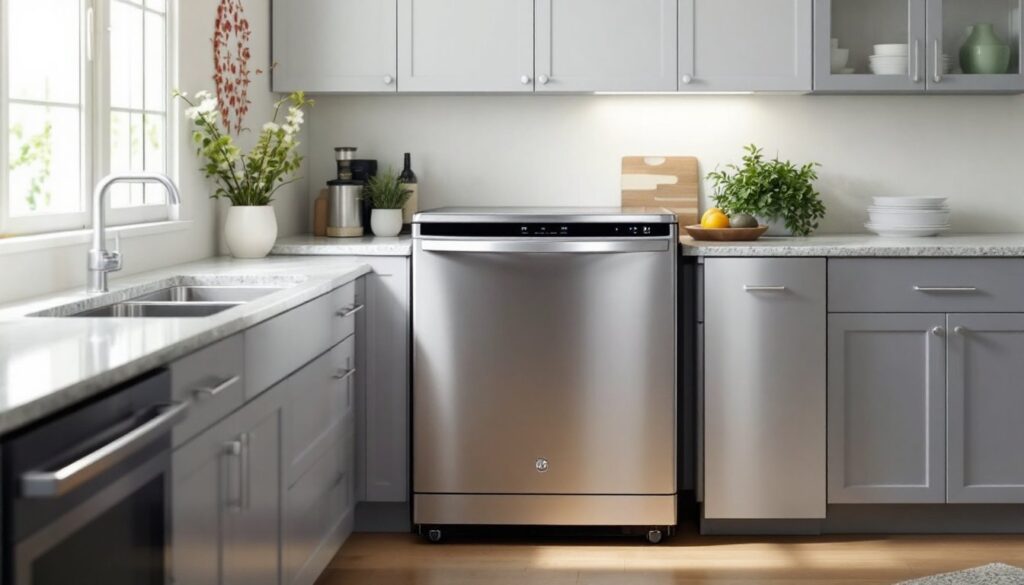
GE portable dishwashers bridge the gap between countertop units and full-size built-ins. They’re heavier and more capable than compact models, typically 24 inches wide and around 200 pounds, so they roll on wheels rather than sit stationary. This means placement flexibility: you can tuck one in a corner, roll it to the sink when needed, and even move it if you relocate. The trade-off is that they’re not designed to integrate seamlessly into cabinetry the way an undercounter dishwasher does, so aesthetics matter if your kitchen is on display.
Key Features and Design Options
GE offers portable models in both stainless steel and black finishes. Most come with a stainless steel tub interior, which resists staining and odors better than plastic. The exterior finish is usually powder-coated steel, durable for daily use but susceptible to fingerprints on stainless models (a microfiber cloth fixes that quickly). Control panels vary: mechanical dial controls are simpler and less prone to failure, while electronic push-button interfaces offer more cycle options and often include a delay-start feature, handy if you want to run a cycle during off-peak hours.
Internally, GE portable models typically feature a three-level spray arm design and multiple wash cycles: normal, heavy, delicate, eco, and quick-rinse options are standard. Some units include a heated dry cycle, which uses a heating element to evaporate water after washing, more effective than passive air drying but uses more energy.
Capacity and Performance Ratings
Most GE portable dishwashers hold 12 place settings, roughly equivalent to a standard 24-inch built-in. A place setting includes a dinner plate, salad plate, cup, saucer, and utensils: use that as a baseline for how many people’s dishes a full load represents. Don’t mistake capacity for power: smaller loads wash better than overloaded racks, so cramming in more won’t necessarily save time or water.
Performance ratings matter. Look for the ENERGY STAR label, it certifies that the unit meets federal water and energy minimums. GE portable dishwashers typically use between 4–5 gallons per cycle, compared to 27 gallons for hand-washing a full load. That’s a real difference over a year, especially if water costs are itemized in your lease. Decibel levels (measured in dB) range from 48–55 dB on most models: anything under 50 dB is considered quiet. Some renters prioritize silence: others don’t care as much. Know your situation before choosing.
Installation and Setup Requirements
Unlike a built-in dishwasher, there’s no rough-in plumbing or electrical work required. A portable unit arrives in a box, and you’ll need about 30 minutes to get it running. The key is understanding what you’re plugging in and what’s touching your sink.
Connecting to Your Kitchen Water Supply
Every GE portable dishwasher ships with a faucet-adapter kit. This typically includes an aerator adapter (the threaded piece that screws onto your faucet), a metal hose, and a check valve. The hose draws water from your kitchen sink tap. Crucially, the kit is a one-way connection: water flows into the dishwasher, not back into your plumbing. That’s what the check valve does, it prevents backflow, which is both a code requirement and a safety measure.
Here’s the setup process:
- Remove your faucet aerator. The aerator is the removable screen at the tip of your kitchen faucet, turn it counterclockwise by hand. Set it aside in a safe place.
- Screw on the GE adapter. Thread the aerator adapter clockwise onto your faucet. Hand-tight is sufficient: don’t use pliers or over-tighten.
- Attach the water inlet hose. The hose has a quick-connect fitting on one end and a standard connection on the other. Screw the standard end into the inlet port on the rear of the dishwasher (you’ll find it labeled). The quick-connect end clips into the adapter on your faucet.
- Verify the connection is secure. Tug gently on both ends of the hose. If water leaks, turn off the faucet and re-tighten the connections slightly.
For drain water, GE portables have two options: spray into a sink basin or direct into a drain. Most come with a spray-head drain attachment, a L-shaped fitting that hangs over the edge of your sink and disperses drain water upward so it falls into the basin rather than pooling. If your sink layout won’t accommodate that, the hose can be inserted directly into a laundry sink or standpipe (common in rentals with washer hookups). Never cap or block the drain hose: backpressure can damage the pump.
If your faucet has a pull-down sprayer or non-standard thread (common on some commercial or specialty faucets), you may need an adapter. GE’s universal adapter kits handle most situations, but measure your faucet thread diameter (typically ½ or ⅜ inch) before buying extras. According to recent product reviews, GE’s included adapters work with 85% of standard kitchen faucets: call customer support if yours isn’t compatible.
Best Practices for Renters
Portable dishwashers are renter gold because they’re non-destructive and removable. But there are a few things to handle beforehand to avoid headaches when you move out.
First, check your lease. Some landlords explicitly prohibit modifications to plumbing, including faucet adapters. It’s unlikely they’ll mind a portable unit, but read the fine print or ask in writing. If approved, take photos of your faucet before you install the adapter, proof that you restored it to its original state when you leave.
Second, know where the water shutoff valve is. It’s usually under the sink or in a basement. If the hose ever ruptures (rare, but possible), you’ll want to cut water in seconds, not minutes. Test it once to be sure it works.
Third, manage the drain carefully. The spray-head attachment works for most sinks, but if splashing bothers you or your sink is too shallow, a standpipe connection is quieter and neater. Many renters with washer hookups already have a standpipe: if you don’t, discuss it with your landlord. Installing a permanent standpipe requires a licensed plumber and likely a permit, so it’s not a renter-friendly option unless your unit already has one.
Finally, document the unit’s condition. Take photos and note any cosmetic damage when it arrives. If the unit fails during the warranty period (typically 1 year for parts, 2 for the compressor on some models), you’ll have proof you didn’t cause it. Keep all receipts and warranty cards. According to home improvement guides, renters who maintain appliances carefully avoid costly replacement fees and deposit disputes.
Maintenance Tips to Extend Your Unit’s Lifespan
A well-maintained portable dishwasher will last 7–10 years. Neglect, and it might fail in 3–4. The difference comes down to a few preventive habits.
Clean the filter regularly. Most GE models have a removable fine-mesh filter at the bottom of the tub. Food and debris clog it quickly. After every few cycles (or weekly, depending on how often you run it), remove the filter and rinse it under running water. A soft brush helps dislodge stuck particles. Never use high-pressure water or soak the filter in bleach: that damages the mesh.
Run a cleaning cycle monthly. GE portable models often include a cleaning/maintenance cycle, check your manual. If yours doesn’t, fill a cup with white vinegar, place it in the top rack, and run the unit empty on a normal cycle. The vinegar dissolves mineral deposits and kills odor-causing bacteria. This is especially important in hard-water areas.
Inspect hoses for cracks or kinks. The water inlet hose and drain hose are vulnerable to abrasion and UV light (if the unit sits in sunlight). Once a year, check for visible cracks, leaks, or permanent creases. Hoses typically last 5–7 years before needing replacement. Kinks restrict flow and strain the pump, so don’t coil them too tightly when moving the unit.
Keep spray arms clear. The rotating spray arms inside the tub can get clogged by food particles or mineral buildup. If dishes aren’t coming clean, remove the spray arms (usually just a twist or slide) and rinse them under running water. Use a toothpick to clear any blocked spray holes.
Check the door seal. The rubber gasket around the door keeps water inside. If it’s cracked or hardened, water will leak during cycles. Wipe it clean with a damp cloth before and after use. If it hardens, you can sometimes revive it with a thin coating of food-grade silicone: if cracking is visible, replacement gaskets are inexpensive (usually $30–80) and worth replacing to avoid water damage.
Use rinse aid and detergent wisely. GE portables work best with a combination of detergent and rinse aid. Rinse aid prevents water spotting and helps dishes dry faster. Detergent pods are convenient, but powder or liquid detergent often costs less and works just as well if you follow the dosage on the box. Over-loading detergent doesn’t clean better: it leaves residue. Home appliance testing consistently shows that proper dosing, not more, delivers the best results.
Level the unit. If your kitchen floor isn’t perfectly level, the unit can rock or put uneven strain on the pump. Most portable dishwashers have adjustable feet at the corners. Use a small level to check, and raise or lower the feet until the unit is stable and doesn’t rock. This takes 5 minutes and prevents vibration and noise.