Table of Contents
ToggleIf you’ve been eyeing cordless impact drivers for your home projects, the Kobalt 24V impact driver deserves serious consideration. Whether you’re fastening deck boards, driving lag bolts, or assembling cabinetry, an impact driver delivers rotational force that a regular drill simply can’t match, without wearing out your wrist in the process. The Kobalt 24V model sits at a sweet spot: affordable, reliable, and powerful enough for most homeowner tasks. This guide walks you through what makes it tick, how it performs in real DIY scenarios, and whether it’s the right addition to your toolbox.
Key Takeaways
- The Kobalt 24V impact driver delivers 1,500 inch-pounds of torque at an affordable price point ($80–130), making it an ideal starter tool for homeowners tackling deck assembly, furniture assembly, and fastening projects.
- Impact drivers use rapid rotational bursts to drive fasteners without stripping screw heads or wearing out your wrist, unlike standard drills that rely on spinning force alone.
- Battery runtime varies by task: the standard 1.3 Ah battery lasts 30–45 minutes for light fastening but drains faster on heavier work, so investing in a 2.0 Ah battery ensures all-day project capability.
- The Kobalt 24V’s compact 3.6-pound design and LED work light fit tight spaces like attics and cabinets while the 1/4-inch hex chuck accepts standard bits without proprietary accessories.
- The Kobalt 24V compares favorably to DeWalt 20V MAX and Makita 18V tools in torque and runtime while costing 30–40% less, though resale value and warranty are stronger with premium brands.
- Skip this tool if you already own an 18V DeWalt or Makita ecosystem, or if you need professional-grade performance for full-time contractor use.
What Makes The Kobalt 24V Impact Driver Stand Out
The Kobalt 24V impact driver delivers a no-nonsense tool designed with homeowners in mind. Unlike basic drills that rely on spinning force, impact drivers use rapid rotational bursts, thousands of impacts per minute, to drive fasteners with less user effort and less risk of stripping screw heads. This matters when you’re assembling furniture, hanging shelves, or driving #10 wood screws into hardwood.
The 24-volt platform strikes a balance between runtime and power. It’s lighter than professional 18-volt models typically found on contractor sites, yet strong enough for decking, framing fasteners, and automotive work. Homeowners appreciate the ergonomic grip and intuitive single-speed trigger, which lets you modulate power on the fly.
Key Features and Specifications
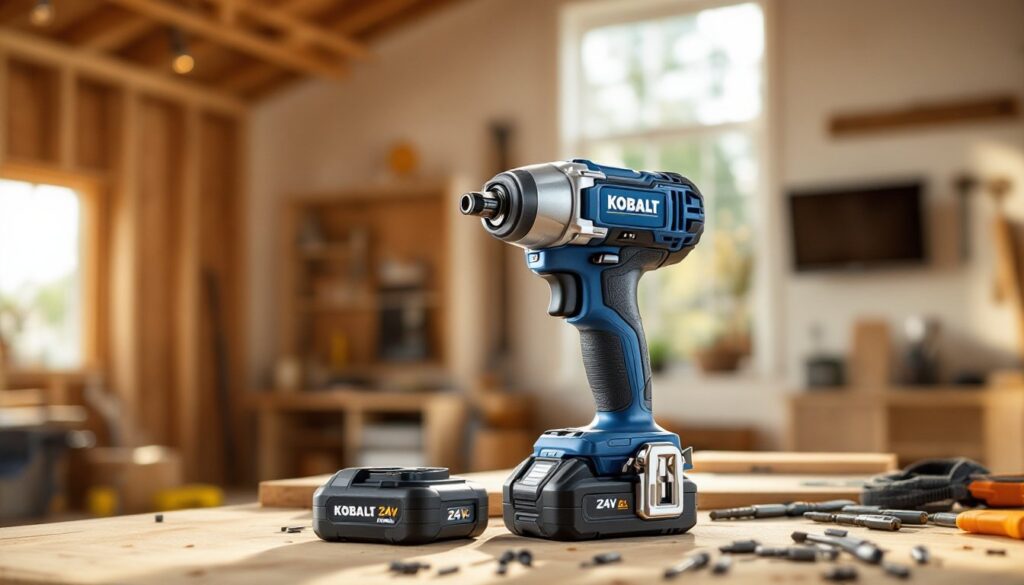
The Kobalt 24V delivers 1,500 inch-pounds of torque, enough to drive 3/8-inch lag bolts without stalling. No-load speed tops out at 3,000 RPM, making it zippy for fastening without racing out of control. The chuck accepts standard 1/4-inch hex bits, so you won’t need proprietary accessories.
One underrated feature: the LED work light. In attics, under sinks, or inside cabinet frames, that light saves you from holding a separate flashlight or squinting. The compact head also fits into tight spaces where bulky drills get stuck. Weight sits around 3.6 pounds, which matters when you’re working overhead or repetitively fastening.
The tool comes with a 24-volt lithium-ion battery (usually 1.3 or 2.0 amp-hours, depending on the kit), a charger, and a belt clip. That belt clip sounds trivial until you’re climbing a ladder and need one hand free to steady yourself.
Battery Life and Power Performance
Battery runtime depends on what you’re doing and which battery pack you start with. The standard 1.3 Ah battery typically lasts 30–45 minutes of continuous fastening with small screws (like #8 deck screws). Heavier work, driving 1/2-inch bolts or cutting 1/2-inch holes, drains it faster, sometimes in 15–20 minutes.
If you’re tackling a full-day project, grab the optional 2.0 Ah battery. Two batteries (one charging while you work) keeps momentum rolling. Charging time is roughly 30 minutes for the standard charger, longer in cold temperatures.
Power delivery stays consistent until the battery hits critical voltage. You won’t experience the gradual slowdown that some cheaper tools exhibit. This reliability matters when you’re installing cabinet hardware or driving fasteners for deck joist repairs, striped or damaged screw heads mean rework.
Battery-powered tools also avoid the extension cord tangles and fuel smell of gas-powered alternatives. For interior work, that’s a real win. Just remember to charge overnight before a weekend project rather than hoping the battery has juice when you need it.
Best DIY Projects for Your Impact Driver
The Kobalt 24V shines across a wide range of homeowner tasks. Deck assembly and repair is a prime use: driving corrosion-resistant deck screws through composite decking into pressure-treated joists is quick and clean. No stripped heads, no mangled wood fiber.
Cabinet and furniture assembly benefits from the compact size and precision control. IKEA-style particle board, hardwood casework, or custom-built shelving all tolerate the driver’s power without splitting fasteners through.
Automotive work, changing oil drain plugs, removing wheel bolts, disassembling engine cover fasteners, plays to the tool’s strength. The 1,500 inch-pounds handles most fasteners on sedans and light trucks without straining.
Interior hanging work like mounting TV brackets, installing towel bars, or fastening drywall repairs goes faster than a cordless drill. The impact action prevents the bit from slipping in stripped or angled pilot holes, a common frustration with standard drills.
Limitation: This isn’t a drill-press replacement. Holes still need pilot holes in hardwood and metal. The tool doesn’t offer the speed of dedicated hole saws for large-diameter work. Also, impact drivers can over-tighten fasteners if you’re not careful, softer materials (drywall anchors, plastic hinges) can strip if you hold the trigger too long. Always back off when you feel resistance.
Comparing The Kobalt 24V to Other Cordless Options
The 24-volt segment includes the DeWalt 20V MAX, Makita 18V, and Milwaukee M18. All three are solid, but they occupy different price tiers. The Kobalt undercuts DeWalt and Milwaukee by 30–40% for a comparable kit, which appeals to homeowners who don’t need commercial-grade durability.
Power-wise, the Kobalt’s 1,500 inch-pounds compares favorably to competing 20V tools (which often deliver 1,400–1,600 inch-pounds). A detailed review from This Old House highlights that the Kobalt holds its own against pricier competitors in torque and runtime metrics.
Battery ecosystem is worth considering. Kobalt batteries work across the entire Kobalt 24V lineup (circular saws, angle grinders, string trimmers), so if you own other Kobalt tools, you get cross-compatibility. DeWalt and Makita offer broader ecosystems, but that diversity costs extra if you’re starting from zero.
The real trade-off: warranty and resale value. Name-brand tools (DeWalt, Milwaukee) command stronger resale value and typically offer longer warranties. Kobalt’s coverage is solid for a big-box brand, but less generous than contractor-grade alternatives. For a homeowner planning to keep the tool 5–10 years and use it occasionally, that difference doesn’t matter much.
Maintenance and Care Tips
Impact drivers are robust tools, but a few habits extend their lifespan. Store the battery separately from the driver in a cool, dry space, avoid garages that freeze or bake in summer heat. Extreme temperatures degrade lithium-ion cells.
Clean the hex chuck regularly. Sawdust and dried fastener bits accumulate, making it harder to seat bits squarely. A quick blast of compressed air or a damp rag prevents this creep.
Inspect the power cable where it enters the charger, and check battery terminals for corrosion or debris. Dirty contacts mean slower charging or failed connections.
Don’t leave the battery on the charger indefinitely once fully charged. Modern chargers have trickle modes that prevent damage, but overnight charging is fine, just don’t forget it plugged in for weeks.
A comprehensive review from CNET discusses maintenance practices specific to the 24V model, including how regular inspection of the motor brushes (if applicable to your model) keeps performance sharp.
Bit care matters too. Bent, chipped, or dull bits reduce efficiency and slip more easily, risking stripped screws. A $10 set of fresh impact-rated bits (they’re tougher than standard drill bits) is cheaper than redriving fasteners or replacing damaged hinges.
If the tool stops driving fasteners with the usual authority, the battery may have lost charge capacity (normal after 100+ charge cycles), or the motor may need brushing. Kobalt sells replacement brushes, though many homeowners simply replace the battery, often cheaper and easier than waiting for repairs.
Should You Buy? Value and Recommendations
If you’re assembling furniture, hanging shelving, or doing light framing work more than once a year, the Kobalt 24V is worth the investment. A basic kit (driver + battery + charger) runs $80–130, a fraction of what you’d pay for DeWalt or Makita equivalents. Over 5 years, that’s ~$16–26 per year, less than a tank of gas.
Where it makes less sense: if you already own an 18V DeWalt or Makita ecosystem, switching to Kobalt means orphaning batteries and chargers. Stick with what you have. Similarly, if you’re a contractor doing fastening work 8 hours daily, the Kobalt’s smaller battery capacity and less robust motor will frustrate you: spend extra for a professional-grade tool.
For occasional homeowners, the Kobalt 24V is a smart starter impact driver. You’ll save time, reduce wrist strain, and finish projects that would otherwise drag on. A detailed Kobalt 24V review digs into real-world use cases and confirms it handles typical household fastening without compromise.
Pro tip: Buy it from a big-box retailer (Lowe’s, Home Depot) rather than online-only sellers. In-store availability for replacement batteries and bits, plus easier returns if something’s defective, saves future headaches. The tool typically includes a basic one-year manufacturer warranty, read it so you know what’s covered.