Table of Contents
ToggleThere’s a moment in every DIY project when a regular drill just gives up. The bit slips, the wrist twists, and the lag bolt sits there mocking you. That’s where a DeWalt impact wrench earns its keep. Built to deliver serious rotational force without wrecking your forearm, these tools have become a quiet favorite among homeowners tackling deck builds, automotive work, and stubborn fastener jobs. This guide walks through what makes them tick, which models actually suit DIY use, and how to pick one without overspending.
Key Takeaways
- A DeWalt impact wrench delivers 700 to 1,400+ ft-lbs of torque by using a rotating mass that strikes an anvil, making it far superior to regular drills for breaking free rusted or seized fasteners.
- The DCF891 (1/2″ compact model with ~330 ft-lbs) suits most homeowners for deck building and automotive work, while high-torque models like the DCF900 (up to 1,200 ft-lbs breakaway torque) are essential for heavy-duty jobs like suspended bolts and farm equipment.
- Always use impact-rated black oxide sockets—not chrome—as chrome sockets can shatter under the high impact loads a DeWalt impact wrench generates.
- Compare fastening torque and breakaway torque separately; breakaway numbers are higher and describe loosening power, not tightening capability.
- Store batteries at room temperature (40-80°F), avoid full discharge, and use a calibrated torque wrench to verify critical fasteners, since impact wrenches prioritize speed over precision.
- These tools exceed 100 dB regularly, so wear hearing protection, and respect the tool’s power by starting in lower torque modes to avoid over-tightening and cracking hardware or materials.
What Makes a DeWalt Impact Wrench Different From a Regular Drill
A drill spins. An impact wrench hammers while it spins. That’s the short version. Inside the housing, a rotating mass strikes an anvil dozens of times per second, delivering bursts of torque that a standard drill simply can’t match.
Where a typical cordless drill tops out around 500-700 in-lbs of torque, a DeWalt impact wrench can deliver 700 to 1,400+ ft-lbs, depending on the model. That’s the difference between stripping a rusted lug nut and breaking it free in two seconds.
Unlike an impact driver, which uses a 1/4-inch hex collet for screws and bits, an impact wrench uses a square drive (typically 3/8″ or 1/2″) for sockets. If the distinction still feels fuzzy, this drill vs impact driver breakdown clears it up nicely. For more on the mechanics, This Old House covers how impact tools work in plain terms.
Top DeWalt Impact Wrench Models Worth Considering
DeWalt’s lineup splits roughly into compact everyday models and high-torque beasts. Picking the right tier matters more than chasing the biggest spec sheet.
Compact 20V Max Options for Everyday Home Projects
For most homeowners, the DCF891 (1/2″ mid-range, ~330 ft-lbs of fastening torque) hits the sweet spot. It handles deck ledger bolts, trailer hitches, and most automotive work without the bulk of a high-torque unit.
The DCF902 3/8″ sub-compact is even lighter, great for tight engine bays or anyone with smaller hands. If you’re cross-shopping with other compact tools, a Flex compact impact driver makes an interesting comparison for screw-driving tasks, though it won’t replace a true wrench.
High-Torque 20V and FlexVolt Models for Heavy-Duty Jobs
When the job involves seized suspension bolts, large lag screws, or farm equipment, step up to the DCF900 (1/2″, up to 1,200 ft-lbs of breakaway torque) or a FlexVolt 60V unit. These are overkill for hanging shelves, but if you wrench on vehicles or build pole barns, they pay for themselves fast.
The tradeoff? Weight. A high-torque model can push 5-6 lbs before the battery. Overhead work gets tiring quickly.
Key Features to Compare Before You Buy
Spec sheets get noisy. These are the features that actually matter on a job site or in a garage:
- Fastening vs. breakaway torque – Breakaway numbers are higher: they describe loosening, not tightening. Compare apples to apples.
- Anvil type – Hog ring, friction ring, or pin detent. Hog ring is most common and balances socket retention with quick changes.
- Speed/torque modes – Three or four settings prevent over-torquing soft fasteners like aluminum wheel studs.
- Brushless motor – Standard on current models. Longer runtime, less heat, fewer moving parts.
- Battery platform – Sticking with 20V Max means batteries swap across drills, saws, and an impact driver bits set workflow.
A quick note on competitors: the Milwaukee impact driver lineup (M18 Fuel, plus the smaller M12 impact driver for tight spaces) is the closest cross-shop. Bob Vila’s comparison of drills and impact tools is worth a read before committing to a battery ecosystem, you’ll likely own that platform for a decade.
Common Home and DIY Projects Where an Impact Wrench Shines
An impact wrench isn’t an everyday tool for most homeowners, but when it’s needed, nothing else will do. Common use cases:
- Automotive work – Rotating tires, removing brake calipers, dropping exhaust components.
- Deck and fence building – Driving 1/2″ structural lag screws into pressure-treated lumber or 6×6 posts (5.5″ actual).
- Trailer and RV maintenance – Hitch balls, leaf-spring U-bolts, wheel bearings.
- Concrete anchors – Tightening wedge anchors or Tapcons into block walls (note: drilling still requires a hammer drill or rotary hammer).
- Mower and tractor repair – Blade bolts often torqued to 70+ ft-lbs and seized with rust.
For pure screw-driving, cabinets, subfloor, drywall, an impact driver is the better tool. If you’re still figuring out where one fits in your kit, this practical guide to impact drivers lays out the basics. And for sizing decisions specifically, impact driver sizes explained is helpful before you commit.
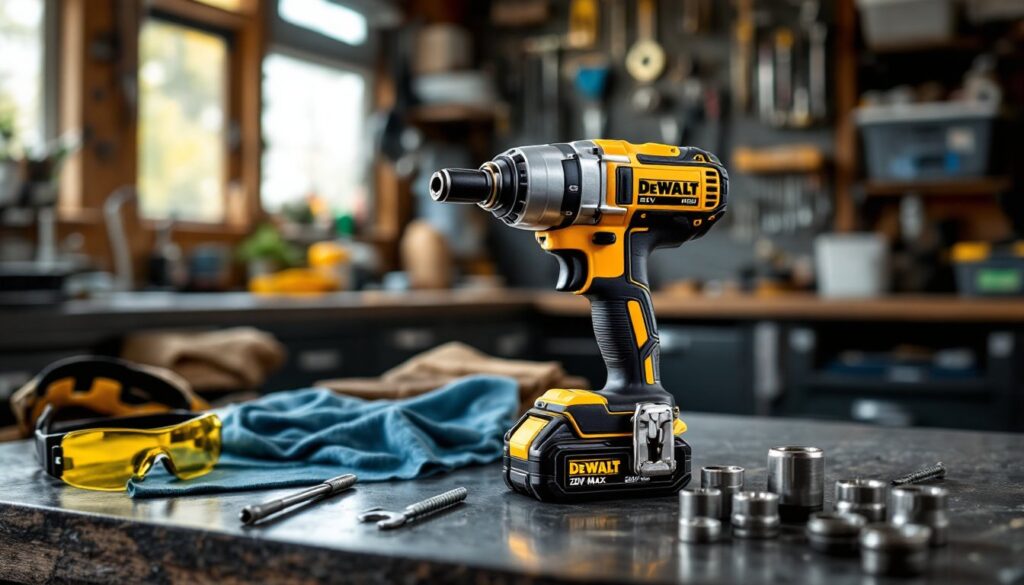
Safety note: Always use impact-rated sockets (black oxide finish, not chrome). Chrome sockets can shatter under impact loads. Wear safety glasses, every time.
Care, Maintenance, and Safety Tips for Long-Term Performance
DeWalt impact wrenches are tough, but they’re not maintenance-free. A few habits will add years to the tool:
- Wipe down the anvil and socket retainer after dusty or muddy work. Grit chews up the hog ring.
- Store batteries at room temperature, ideally between 40-80°F. Lithium-ion hates extreme heat and freezing garages.
- Don’t fully discharge batteries. Top them off when they hit 20-30%.
- Check torque with a calibrated torque wrench for critical fasteners (wheel lugs, head bolts). Impact wrenches are fast, not precise.
- Wear hearing protection, these tools regularly exceed 100 dB at the user’s ear.
If you’re shopping across brands, comparing the Kobalt 24V impact driver or a Klein impact driver option can help benchmark where DeWalt’s value lands. Popular Mechanics also has a solid breakdown of which tool to choose for different project types.
Finally: respect the torque. Over-tightening a wheel stud or a deck bolt with 1,000+ ft-lbs of force can snap hardware or crack the material underneath. Start in a lower mode, then step up only if needed. The tool’s power is the easy part, knowing when to back off is what separates a confident DIYer from a frustrated one.