Table of Contents
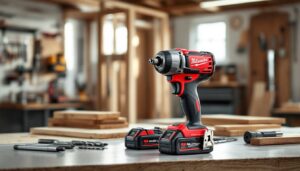
ToggleThe Milwaukee M12 impact driver has earned its place in home garages and DIY workshops across the country for one simple reason: it delivers professional-grade fastening power in a package that doesn’t exhaust your wrists after an hour on a ladder. Whether you’re hanging shelves, assembling deck railings, or driving lag bolts into pressure-treated lumber, this compact tool punches above its weight class. For homeowners tackling serious projects without the bulk and price tag of full-size impact drivers, the Milwaukee 1/2 impact driver represents a practical middle ground. This guide covers what makes the M12 lineup stand out, which models fit different budgets, and whether one belongs in your toolbox.
Key Takeaways
- The Milwaukee M12 impact driver delivers 1,500 in-lbs of fastening torque and 2,500 RPM, making it powerful enough for lag bolts and rusted fasteners while remaining lightweight at 3.6 pounds for overhead work.
- The compact 1/2-inch hex chuck design fits tight spaces where full-size impact drivers won’t, and the low-mounted battery placement reduces fatigue during extended projects on ladders and in awkward positions.
- Milwaukee M12 impact driver pricing ranges from $79–$99 for bare tools to $149–$179 for complete kits, with excellent battery compatibility across the M12 ecosystem and strong resale value compared to competing brands.
- The M12 Gen 4 represents the latest efficiency improvement with refined ergonomics and cooler motor performance, though Gen 3 models remain reliable for homeowners tackling repetitive fastening tasks.
- Impact-rated bits are essential for the M12 impact driver to prevent bit shattering; standard twist bits will fail under impact force and should never be used.
- This tool is ideal for DIYers who drive fasteners 50+ times annually or tackle serious projects like deck railings and shelving, but renting may be more practical for occasional one-off users.
Performance and Key Features
Power and Speed Capabilities
The Milwaukee M12 impact driver delivers 1,500 in-lbs of fastening torque, enough to drive 3-inch lag bolts through doubled-up framing or break loose rusted bolts without straining. Most homeowners never push it to the limit, but that headroom means you won’t hit a wall when tackling unexpected resistance. Rotational speed tops out around 2,500 rotations per minute (RPM), which sounds modest compared to full-size drills but translates to smooth, controlled power for precision work like assembling furniture or installing cabinet hardware.
The impact mechanism, rapid-fire rotational strikes from an internal hammer, is what separates an impact driver from a cordless drill. It concentrates force on the fastener without requiring upper-body strength. You’re not fighting the tool: the tool is doing the work. For repetitive fastening (think installing a 60-piece deck rail), this cuts fatigue in half compared to a drill.
Design and Usability
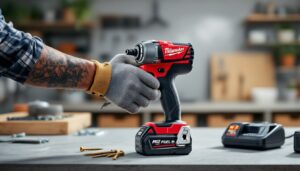
The M12 weighs around 3.6 pounds bare tool, making it lightweight enough to use overhead without your shoulder filing a complaint by day two. The compact head fits into tight spaces, between wall studs, under cabinetry, inside cabinet frames, where a full-size Milwaukee M18 FUEL impact driver would simply not fit. The 1/2-inch hex chuck accepts standard impact-rated bits, and the rubber overmold grip stays secure even with one hand, which matters when you’re balancing on a ladder or reaching into an awkward corner.
Battery placement is low-mounted and centered, keeping the tool balanced and reducing tip-heavy fatigue. The integrated LED work light isn’t fancy, but it eliminates the headlamp requirement for interior projects or shaded areas. A variable-speed trigger lets you pulse power for delicate fastening, though you’ll mostly use full throttle once you get comfortable with the feel.
Specifications and Technical Details
The Milwaukee M12 platform uses 12-volt lithium-ion batteries available in 1.5Ah, 2.0Ah, 3.0Ah, and 6.0Ah configurations. Compact 1.5Ah and 2.0Ah packs charge in 30 to 45 minutes with a rapid charger: if you’re impatient (or working multiple projects), a 6.0Ah pack runs longer but takes a full hour to charge. Real-world runtime on a 1.5Ah battery is roughly 45 minutes of active fastening, assuming you’re not torquing against serious resistance continuously.
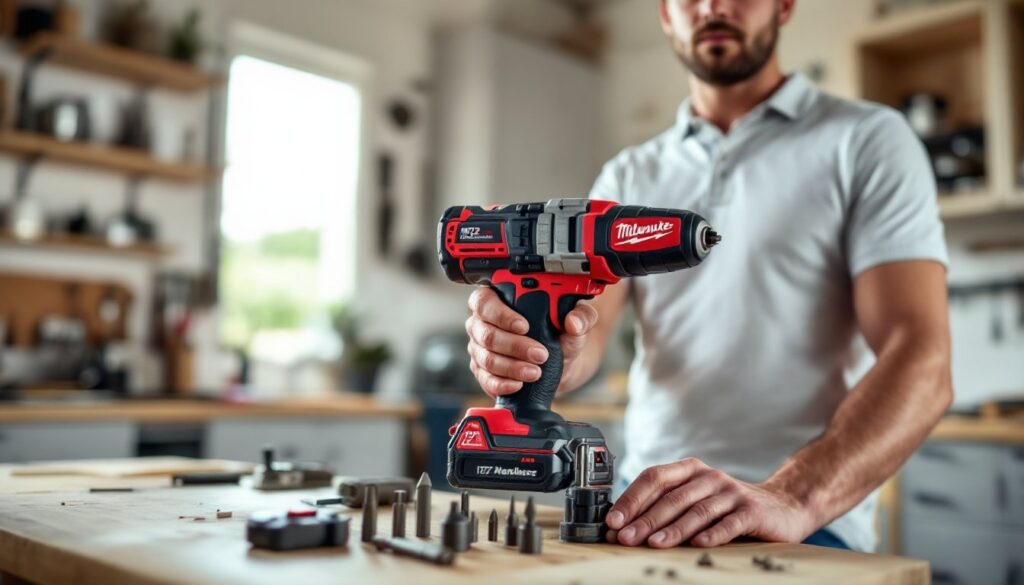
The 1/2-inch hex chuck accepts all standard impact bits, not the cheaper twist bits, which will shatter under impact force. This seems obvious, but it’s worth mentioning because it’s the easiest mistake to make when starting out. Buy dedicated impact-rated bits: the Milwaukee Shockwave 100Pc impact driver bit set packout includes common fastening sizes and outlasts generic alternatives.
Weight distribution matters for overhead or angled work. The 3.6-pound tool + battery (another 0.5 pounds for a 2.0Ah) = roughly 4.1 pounds total in your hand. A full-size M18 tips the scales at nearly 6 pounds, and that extra 2 pounds makes a real difference after 20 minutes on an extension ladder.
Build quality is industrial-grade. The housing is reinforced polymer with no plastic flex, and the motor bearings are steel (not needle bearings like budget brands). This tool will survive a six-foot drop onto concrete and keep running, not recommended, but common enough on job sites to speak to durability.
Milwaukee M12 Models and Options
Milwaukee offers several M12 impact configurations. The M12 2402-20 (bare tool) costs less upfront if you already own M12 batteries and a charger. The M12 2403-22 (compact kit) includes two 1.5Ah batteries and a charger, ideal for someone building a cordless toolkit from scratch. If you’re upgrading within the M12 ecosystem, this kit minimizes extra gear clutter.
The M12 Gen 4 represents the latest revision, featuring improved ergonomics and slightly higher rotational efficiency compared to earlier generations. If you’re buying new, the Gen 4 is worth the modest price premium over older stock. The difference isn’t dramatic, you won’t suddenly drive fasteners twice as fast, but it feels more refined in hand and the motor runs cooler under load.
There’s overlap with the Milwaukee 1/2 impact driver sizing and the smaller 1/4-inch impact drivers (like the M12 models used for automotive work). Don’t confuse them. The 1/2-inch hex chuck handles construction-grade fasteners: the 1/4-inch is designed for precision fastening and smaller hardware. For home improvement, you want the 1/2-inch unless you’re rebuilding a motorcycle.
For those needing more punch, the Milwaukee M18 FUEL impact driver delivers twice the torque but loses the compact advantage. The M12 Impact Driver Gen 4 splits the difference with newer efficiency gains. For homeowners without professional-scale projects, the base M12 remains the sweet spot.
Pricing and Value
A bare M12 impact driver runs $79–$99 depending on sales and retailer. A compact kit (tool + two batteries + charger) costs $149–$179. These prices are competitive: the only cheaper alternatives are no-name brands with motors that quit after 18 months, and the hassle of warranty claims isn’t worth saving $40.
Battery compatibility is the unspoken cost factor. If you already own other M12 tools, a drill, a jigsaw, a reciprocating saw, the batteries cross-charge, and you’re adding a tool without duplicating charger expense. If the M12 is your first cordless tool, budget an extra $30–$50 for a quality multi-tool charger (not the cheap single-bay models).
Resale value is another consideration. Milwaukee tools hold their used market value better than most brands. A two-year-old M12 impact driver in good condition still commands $50–$70 on the secondhand market, which softens the initial investment if you upgrade later. That’s not true of corner-store brands.
For value-conscious buyers, home renovation cost guides can help contextualize tool investment within a larger project budget. Whether an impact driver is worth buying depends on whether you’re a one-off DIYer (consider renting) or someone who’ll drive fasteners 50+ times a year (buy). Once you own one, you’ll find reasons to use it, that’s the real test of value.
Conclusion
The Milwaukee M12 impact driver is a deliberate tool for a specific job. It’s not a drill, it’s not a framing nailer, and it won’t replace a manual screwdriver for delicate electrical work. But for repetitive fastening, overhead work, and situations where arm fatigue kills productivity, it’s indispensable. The compact size means it’ll live in your toolbox year-round, not buried in a garage corner. The price is accessible without compromising durability. If home projects are in your future, this tool belongs on the shopping list.