Table of Contents
ToggleThe Milwaukee M12 FUEL impact driver has earned a solid reputation as a workhorse for homeowners tackling fastening jobs around the house. Whether you’re driving lag bolts into deck framing, assembling furniture, or hanging heavy cabinets, this compact cordless impact driver delivers the rotational force you need without the bulk of larger models. Unlike a standard drill, an impact driver uses rapid hammer blows to transfer power directly into fasteners, making it far more effective at breaking loose stubborn screws and driving long fasteners into dense materials. If you’re considering adding a Milwaukee impact driver to your toolkit, this guide walks through what makes the M12 FUEL tick, how it performs on real projects, and whether it’s the right fit for your DIY ambitions.
Key Takeaways
- The Milwaukee M12 FUEL impact driver delivers 2,500 in-lbs of torque and 3,000 RPM, making it ideal for fastening tasks like deck building, cabinet hanging, and hardware removal without the bulk of larger models.
- Impact drivers use rapid hammer blows to transfer power directly into fasteners, enabling them to break loose stubborn, corroded bolts in seconds and outperform standard drills on fastening jobs.
- Battery runtime ranges from 1.5 to 2 hours on a 2.0Ah battery or 3 to 4 hours on a 4.0Ah battery, with quick 30-minute charging times making it practical for extended home projects.
- The compact 3.5-inch head and 3 to 3.5-pound weight make the Milwaukee M12 FUEL perfect for working in tight spaces like cabinet interiors and between wall studs without causing wrist fatigue.
- M12 ecosystem compatibility means any M12 battery powers this driver and vice versa, giving homeowners flexibility to build a complete cordless toolkit and swap batteries across multiple tools.
What You Get: Overview, Options, and In-The-Box Essentials
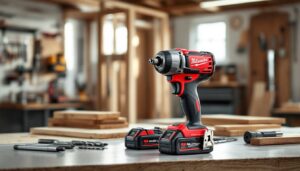
The Milwaukee M12 FUEL impact driver comes in several configurations depending on where you shop and what bundle you choose. Most commonly, you’ll find it sold as a bare tool, a single-battery kit with one 2.0Ah battery and charger, or a two-battery kit with both a 2.0Ah and 4.0Ah battery. The bare tool is the most affordable entry point if you already own batteries compatible with Milwaukee’s M12 platform.
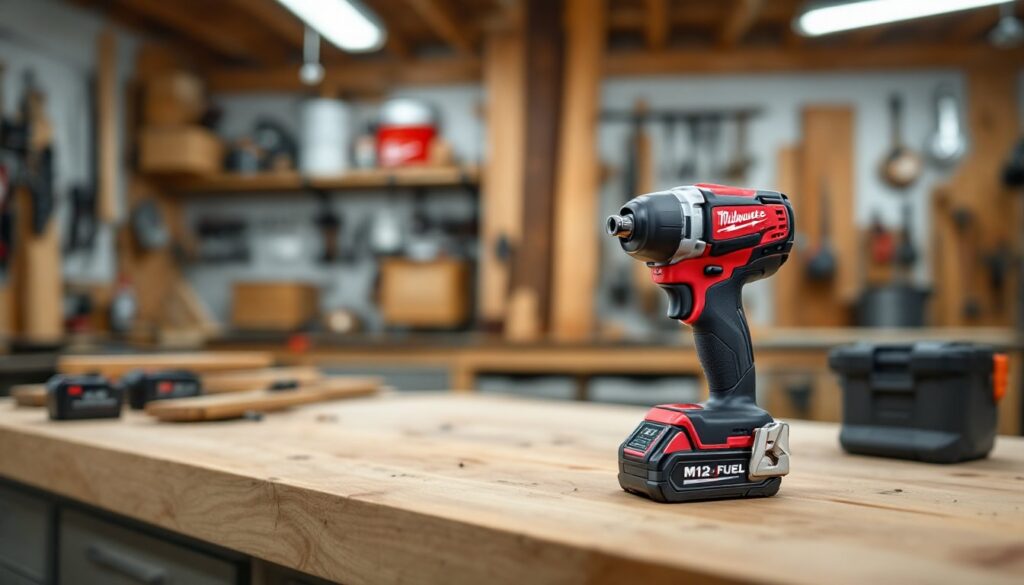
Inside the box, you’ll get the impact driver itself, a side handle (often called a D-handle), and a ¼-inch hex chuck, the standard size for impact driver bits. Depending on your kit, you may also receive a charger and one or more batteries. The side handle isn’t just an accessory: it’s essential for control when driving fasteners or breaking loose stuck bolts. The compact head measures roughly 3.5 inches long and 2.5 inches wide, making it easy to work in tight spots like cabinet interiors or between wall studs. Weight runs around 3 to 3.5 pounds depending on battery choice, so fatigue isn’t an issue during extended use.
One thing to note: the M12 FUEL doesn’t include a carrying case or bit set. You’ll need to purchase impact-rated bits separately, using standard drill bits will lead to stripped or broken tips.
Key Specs and Performance Metrics That Matter
When comparing impact drivers, three metrics matter most: torque, speed, and runtime. The Milwaukee M12 FUEL delivers 2,500 in-lbs of max torque, enough to drive 3½-inch lag bolts into dimensional lumber with one hand and to break free hardware that’s been corroded for years. That’s substantially more punch than older M12 models and on par with competing compact cordless impact drivers from Dewalt and Makita.
Rotational speed maxes out at 3,000 RPM, which sounds fast until you realize that’s intentionally engineered for control and precision rather than raw speed. Lower RPM means you have better command over fastener placement and less risk of stripping screw heads.
Runtime depends heavily on your battery. A 2.0Ah battery delivers roughly 1.5 to 2 hours of intermittent work before needing a charge. Step up to the 4.0Ah battery, and you’re looking at 3 to 4 hours. The M12 charger is reasonably quick, about 30 minutes for a 2.0Ah pack, though a dual-port charger will save time if you’re rotating batteries on a longer project.
The M12 FUEL is also part of Milwaukee’s M12 ecosystem, which means any M12 battery (from sanders to flashlights) will power this driver and vice versa. That cross-compatibility is a huge advantage if you’re already invested in the M12 platform. For those starting fresh, the M12 FUEL pairs well with other compact Milwaukee tools like the M12 circular saw and M12 drill-driver to build a cohesive cordless toolkit without investing in heavier M18 equipment.
Real-World Performance: Speed, Power, and Usability
Torque and Speed in Action
The difference between an impact driver and a drill becomes clear the moment you use one on a real project. Driving ten 3-inch deckboard screws into pressure-treated joist stock will exhaust your wrist on a cordless drill in seconds. With the M12 FUEL, you’re applying steady downward pressure and letting the tool do the work, each fastener sinks in roughly 3 to 4 seconds. The hammering sensation is noticeable but never jarring: the tool vibrates in your hand rather than twisting violently if the bit catches.
Breaking loose rusted bolts is where the impact driver truly shines. A seized ¼-inch bolt on old deck hardware that resisted hand tools for 10 minutes yields to the M12 FUEL in under 30 seconds. That rotational force, combined with rapid percussive strikes, defeats corrosion far more effectively than steady torque alone.
One caveat: the 2,500 in-lbs figure is peak torque during fastening. You won’t see that constant output during every stroke: the motor ramps up torque on demand. That’s by design, it preserves battery life and prevents overkill torque that would strip fastener heads.
Comfort and Convenience Features
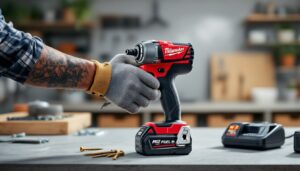
The M12 FUEL’s ergonomics deserve real credit. The side handle has a rubber overmold that grips comfortably even with gloved hands, and its angle doesn’t force your wrist into an awkward bend. The tool itself feels balanced, not nose-heavy like some compact drivers. Battery ejection is smooth: one-handed removal is possible, which matters when you’re holding a fastened shelf with your other hand.
LED worklight is standard and genuinely useful in cabinets or under-deck spaces. It’s not bright enough to replace a separate light source, but it illuminates your immediate fastening area well enough to verify bit seating before driving.
Bit slippage isn’t an issue with the ¼-inch hex chuck. It’s a friction-fit design (no spring collet), which means bits stay put even under shock loads. You will need to replace a bit occasionally when the hex flats wear, but that’s normal wear for an impact driver.
Battery indicator is a simple three-light LED system on the battery itself, not the most detailed, but adequate for quick checks. You’ll know roughly when you’re down to 30% capacity.
Is the Milwaukee M12 FUEL Right for Your Projects?
Choose the M12 FUEL if your work includes fastening tasks like deck building, cabinet hanging, furniture assembly, or general home repair. It excels at jobs where you’re driving screws and bolts into wood, composite, or light metal. The compact size is invaluable in confined spaces, inside cabinets, between studs, or under eaves, where a larger impact driver can’t fit.
If you already own other M12 tools, the decision is simpler: battery and charger compatibility make it a natural addition. Cross-shop it against the M12 hex impact driver if you prefer a bare-knuckle design without the side handle, or consider the M12 1/4 hex impact driver for slightly different ergonomics.
Skip it if your projects routinely demand the power of a full-size impact driver. Structural work that requires machine fasteners larger than ½ inch, or repeatedly driving massive bolts, calls for the Milwaukee M18 FUEL impact driver, which delivers 3,400 in-lbs of torque. Likewise, if you’re a contractor billing hours, the M18’s longer runtime and higher torque justify the added weight.
For homeowners juggling multiple projects without daily tool use, the M12 FUEL strikes the right balance between power and practicality. It’s light enough for all-day comfort, strong enough for 95% of residential fastening tasks, and affordable enough not to regret if it sits idle for months. According to expert comparisons on Bob Vila’s best Milwaukee impact drivers, the M12 FUEL consistently ranks as a top choice for DIY and light professional use, confirming its solid standing in the cordless tool market.
Conclusion
The Milwaukee M12 FUEL impact driver delivers genuine utility for homeowners without unnecessary bulk or overengineered features you won’t use. Its 2,500 in-lbs torque, compact footprint, and M12 ecosystem compatibility make it a smart addition to any DIY toolkit. Real-world testing confirms it handles deck fastening, cabinet work, and hardware replacement with speed and ease that a standard drill simply can’t match. If your projects center on fastening tasks and you value compactness, this driver earns its place in your garage.